
# gstupdate
12 posts in `gstupdate` tag
GST Update: Auto Suspension for Not Updating Bank Details
Starting 5th December 2025, businesses registered under GST must update their bank account details within 30 days of registration or before filing GSTR-1/IFF, whichever is earlier. As per Rule 10A, failure to comply will result in automatic suspension of GST registration. The update process requires furnishing bank account number, IFSC code, and a cancelled cheque or bank statement via the GST portal. While OIDAR and NRTP taxpayers are exempt, OIDAR taxpayers with a representative in India must provide bank details. Timely compliance ensures uninterrupted GST registration and avoids cancellation proceedings.
-
By Krishna


Key Changes in GSTR-9 and GSTR-9C for FY 2024-25: Everything You Should Know
The GST portal has opened GSTR-9 and GSTR-9C for FY 2024-25 with a filing deadline of December 31, 2025. This guide explains the key changes in both forms, filing thresholds, auto-population details, and practical tips to file on time and avoid penalties—written in clear, simple language.
-
By Krishna

Supreme Court Protects CAs: Issuing Form 15CB Is Not Money Laundering
The Supreme Court of India has upheld that Chartered Accountants cannot be prosecuted for money laundering simply for issuing Form 15CB, as it is a statutory duty under the Income Tax Act. This ruling protects professionals from being unfairly targeted and clarifies the limited role of CAs in compliance matters.
-
By Krishna
Quick GST Registration in 3 Days for Small Businesses
The GST portal has launched a faster registration process for low-risk taxpayers. With Aadhaar authentication and proper document upload, eligible applicants can now get GST registration within 3 working days.
-
By Krishna
GST Registration Made Easy: Rule 9A & Rule 14A
The Central Government has introduced two new GST rules—Rule 9A and Rule 14A—effective from November 1, 2025. These updates simplify and speed up the registration process for low-risk taxpayers and small B2B suppliers
-
By Krishna

Administrative clarity wins: Same officer to handle Section 74 to Section 73 conversion
The CBIC has clarified that when a GST case originally issued under Section 74 is converted to Section 73 following an appellate or court order, the same original adjudicating officer remains the Proper Officer for re-determination under Section 75(2). This avoids jurisdictional transfers, maintains consistency, and supports timely compliance with the two-year limit under Section 75(3).
-
By Krishna
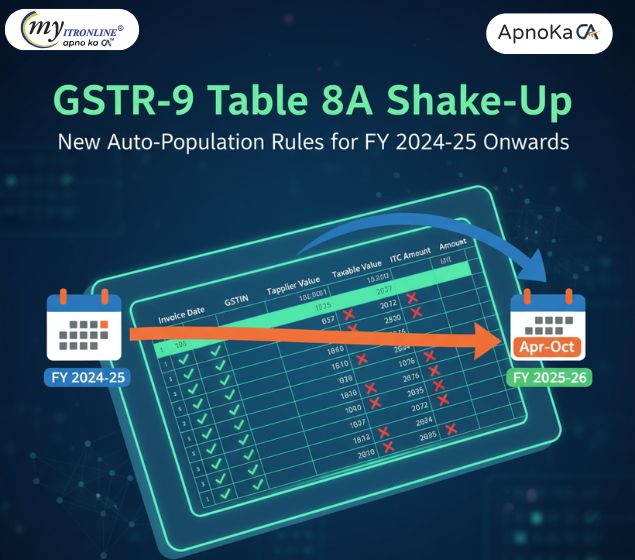
GSTR-9 Table 8A Shake-Up: New Auto-Population Rules for FY 2024-25
GSTN has changed how Table 8A in GSTR-9 is auto-filled. Starting FY 2024-25, it will include invoices from both the current and next financial year, making ITC reconciliation more accurate. Learn what’s included, what’s excluded, and how to prepare.
-
By Krishna
GSTR-9 and GSTR-9C Filing for FY 2024-25 is Now Open
The GST portal has enabled GSTR-9 and GSTR-9C forms for FY 2024-25 starting October 12, 2025. Taxpayers can now file their annual returns and reconciliation statements before the December 31 deadline. Learn who needs to file and how to prepare.
-
By Krishna

GSTN Clarifies: No Change in ITC Auto-Population from GSTR-2B to GSTR-3B
GSTN has issued a clarification confirming that the auto-population of Input Tax Credit (ITC) from GSTR-2B to GSTR-3B remains unchanged, even after the implementation of the Invoice Management System (IMS). GSTR-2B will continue to be generated automatically on the 14th of every month. This update helps clear confusion and reassures taxpayers that their filing process remains stable.
-
By Krishna
GST Changes from October 2025: What You Need to Know
Starting October 2025, the GST system will undergo major changes affecting how businesses file returns and claim input tax credit. Key updates include manual ITC acceptance, locked GSTR-3B liabilities, new credit note rules, and invoice-level TDS reporting. Businesses must adapt to stay compliant and avoid filing issues.
-
By Krishna
GST Compliance Update: CBIC Removes DIN Requirement for Portal-Based Notices
CBIC has released Circular No. 249/06/2025-GST, removing the mandatory use of DIN for communications issued via the GST portal. However, DIN remains compulsory for eOffice-based documents, as clarified in Circulars No. 23/2025 - Customs and 252/09/2025 - GST. This blog explains the changes and what taxpayers need to know.
-
By Krishna

Big Changes Coming to GST on October 1, 2025: What Your Business Needs to Know
The Indian government has announced significant GST updates, effective October 1, 2025, stemming from the Finance Act, 2025. These amendments will impact definitions, voucher taxation, Input Tax Credit (ITC) on plant & machinery (retrospectively from 2017), return filing procedures, appeal processes, and introduce a new 'track & trace' system with associated penalties. Businesses must prepare for these changes by reviewing operations, updating systems, and training staff to ensure compliance and manage potential cash flow implications.
-
By Krishna