
# digitalindia
12 posts in `digitalindia` tag
Capital Gains Accounts Scheme (CGAS) 2025: Major Digital Updates for Taxpayers
The Capital Gains Accounts Scheme (CGAS) has been overhauled for FY 2025-26. Key changes include authorization of 19 private banks (HDFC, ICICI, Axis), acceptance of all major digital payment modes (UPI, NEFT, Cards), online account closure, and the inclusion of Section 54GA (SEZ relocation) exemption.
-
By Krishna



Rise of the Machine: How AI is Changing Tax Compliance in India
India’s tax system is being reshaped by AI and Big Data. Through Project Insight, the Income Tax Department now tracks bank data, investments, and lifestyle transactions in real time, flagging anomalies and ensuring compliance.
-
By Krishna

EPFO Stops UAN Activation on Portal Here’s the New Way
EPFO has stopped UAN activation on its Member Sewa portal. The process is now available only through the UMANG App using Aadhaar-based Face Authentication. This ensures better security, fraud prevention, and smoother services.
-
By Krishna
GST 2.0: A Game Changer for India? Simplified Taxes & Economic Boost
This blog post provides a comprehensive overview of India's GST 2.0, implemented on September 22, 2025. It details the key features, including the reduction of tax slabs to 5% and 18% (with a new 40% for luxury/sin goods), lower taxes on essential goods, durables, and automobiles, and increased prices for luxury items. The article identifies beneficiaries like everyday households, the middle class, farmers, healthcare consumers, and MSMEs. It also addresses potential challenges such as revenue shortfall, price pass-through issues, and transition headaches for businesses. Finally, it outlines expected economic ripples and crucial factors to monitor for the reform's success, concluding that GST 2.0 is a bold step towards simplifying life for millions. An appendix with sample MRP comparisons is also included.
-
By Krishna
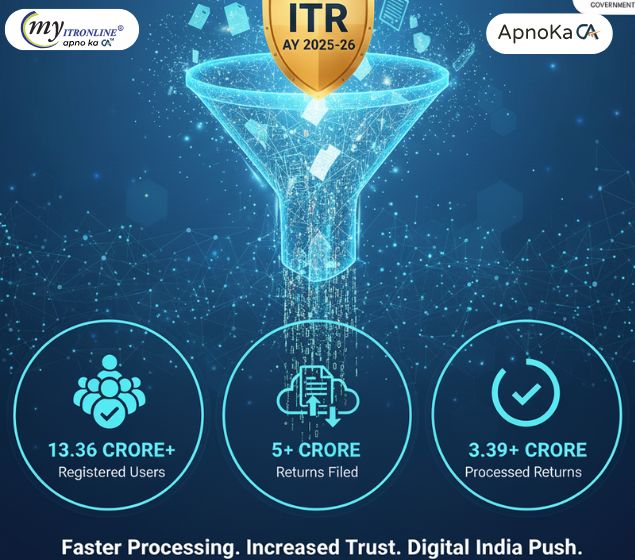
Our Success Enablers: Key Highlights of ITR Filing for AY 2025-26
This blog post provides a detailed overview of the key highlights from the Income Tax Return (ITR) filing season for Assessment Year (AY) 2025-26, as of September 8, 2025. It showcases significant statistics including over 13.36 crore registered users, more than 5 crore returns filed, nearly 4.72 crore verified returns, and over 3.39 crore processed returns. The post emphasizes the growing trust in the e-filing platform, faster processing times, and the success of India's digital transformation in tax administration, positioning the Income Tax Department as "Success Enablers."
-
By Krishna
CBDT’s Big Move: Corrective Amendment to the Income-tax Act, 2025
The Central Board of Direct Taxes (CBDT) has issued a significant corrigendum to the recently enacted Income-tax Act, 2025. This blog post delves into the necessity and impact of these corrections, highlighting various typographical, grammatical, and structural fixes. It explains why such legislative "housekeeping" is crucial for legal accuracy and preventing disputes, while also providing context on the broader reforms introduced by the Income-tax Act, 2025, including a simplified structure, unified tax year, and digital-first assessments. The key takeaway emphasizes that while the corrigendum doesn't alter tax policy substance, it ensures the Act is legally sound and ready for smooth implementation, supporting India's goal of a simpler, more transparent tax framework.
-
By Krishna

CBDT Overhauls Income Tax: Simpler Forms & Stronger Data Protection by 2025
The Central Board of Direct Taxes (CBDT) is implementing significant changes to income tax forms and rules, effective April 2025, following the new Income Tax Act of 2025. The initiative focuses on simplifying tax filing through smart, pre-filled forms, drastically reducing the number of forms from 200 to under 100, and ensuring robust protection for digital data collected during tax procedures. While new ITR forms are slated for 2027, immediate efforts are on TDS, TCS, advance tax, and exemption forms. These reforms aim to enhance transparency, ease compliance, and create a smarter, safer tax environment for Indian taxpayers.
-
By Krishna
.jpg)
Goodbye 1961, Hello 2025: India's New Income Tax Act Explained in Simple Terms
This blog post details India's landmark decision to replace the sixty-year-old Income-tax Act, 1961, with the new, simplified Income-tax Act, 2025, which will be effective from April 1, 2026. It breaks down the key changes in simple terms, explaining the reduction in legal complexity, the introduction of a unified "Tax Year," clearer definitions for digital assets, and the move towards faceless, technology-driven tax processes. The post highlights how these changes aim to create a more transparent, efficient, and taxpayer-friendly direct tax system for individuals and businesses across the country.
-
By Krishna

Income Tax E-Filing: Aadhaar OTP Verification Becomes Mandatory – Your Essential Guide
This blog post details the recent mandatory implementation of Aadhaar OTP verification on the Income Tax e-Filing portal for ITR verification and other services. It explains the reasons behind this shift, focusing on enhanced security, streamlined processes, and data integration. The post outlines the crucial impact on taxpayers, emphasizing the necessity of PAN-Aadhaar linking and updated mobile numbers. It also provides actionable steps for those not yet ready and reiterates the benefits of this digital transformation for tax administration in India.
-
By Krishna

ITR-B Online: New Ease for Section 158BC Notices
This blog post details a significant update for taxpayers who have received a notice under Section 158BC of the Income-tax Act, 1961. It explains that Form ITR-B, a special return for undisclosed income found during past search and seizure operations, can now be submitted conveniently through the Income Tax portal's e-Proceeding tab. The article clarifies what a Section 158BC notice entails, highlights the benefits of online submission (convenience, efficiency, transparency), provides step-by-step guidance, and emphasizes the crucial role of professional advice for these complex assessments.
-
By Krishna

Income Tax in India: Are You Prepared for July 2025?
This blog post provides a comprehensive overview of the significant income tax changes coming into effect in India from July 1, 2025. It details the more attractive new tax regime with revised slabs and increased deductions, the extended ITR filing deadline, the mandate for Aadhaar in PAN applications, and the real-time PAN-bank linking system. Furthermore, it touches upon the updated ITR forms and the broader proposals of the Income Tax Bill 2025, offering taxpayers crucial insights for compliance and effective tax planning.
-
By Krishna

New E-Way Bill 2.0: What You Need to Know
This blog post provides a comprehensive yet concise overview of the upcoming E-Way Bill 2.0 system, effective July 1, 2025. It highlights the core objective of ensuring business continuity through a dual-portal operation and real-time data synchronization. Key enhancements, including new service functionalities and API integrations, are detailed, along with the benefits for taxpayers and transporters such as zero downtime and increased efficiency. The post concludes with actionable advice for businesses to prepare for the transition.
-
By Krishna